
FSM-Resine
Acrylate-Based Flame Retardants for SLA & DLP 3D Printing
In Additive manufacturing is a process in which 3D objects are built layer by layer by adding material. This technology increases design freedom, shortens time to market, and enables on-demand production, thereby improving industrial sustainability. The 3D printing industry is a rapidly growing sector worldwide, including applications in consumer goods, aerospace, and the chemical industry. In 2025, 43% of industrial companies in Germany already use additive manufacturing in practice.
Stereolithography (SLA) and Digital Light Processing (DLP) are 3D printing technologies based on photopolymerization. Typically, acrylate-based resins containing a photoinitiator are used. In the printing process, a laser or projector serves as a light source to cure the resin layer by layer using UV light. These technologies offer significant advantages, such as the ability to produce high-quality components with high resolution and smooth surfaces.
Despite the strong growth of 3D printing technologies, there are still very limited flame-retardant solutions available, especially for SLA and DLP processes. One key challenge is that most conventional flame retardants cannot be reactively incorporated into the polymer matrix.
The aim of this project is therefore to develop new acrylate-based flame retardants for use in light-curable 3D printing resins. The goal is to create highly effective, light-curable, and more environmentally friendly systems. In addition, the project addresses the toxicological and environmental concerns associated with conventional halogenated flame retardants, with the aim of providing safer and more sustainable alternatives.
Besides flame retardancy, the compatibility of the additives with the resin and their homogeneous distribution are crucial, as they strongly influence the mechanical properties of the final printed parts. Therefore, the developed systems will be comprehensively characterized with respect to fire behavior, thermal stability, reactivity, and mechanical performance.
The project is carried out in close cooperation with SKZ. At DTNW, the focus is on the development, formulation, and characterization of flame-retardant resin systems. SKZ is responsible for processing the materials using SLA and DLP technologies and for evaluating printability as well as the quality of the printed components under practical conditions.
The development of efficient, light-curable flame-retardant systems that are effective at low concentrations offers significant application potential and a clear competitive advantage. Close collaboration with industrial users and chemical manufacturers ensures that the project results can be transferred directly into practical applications.
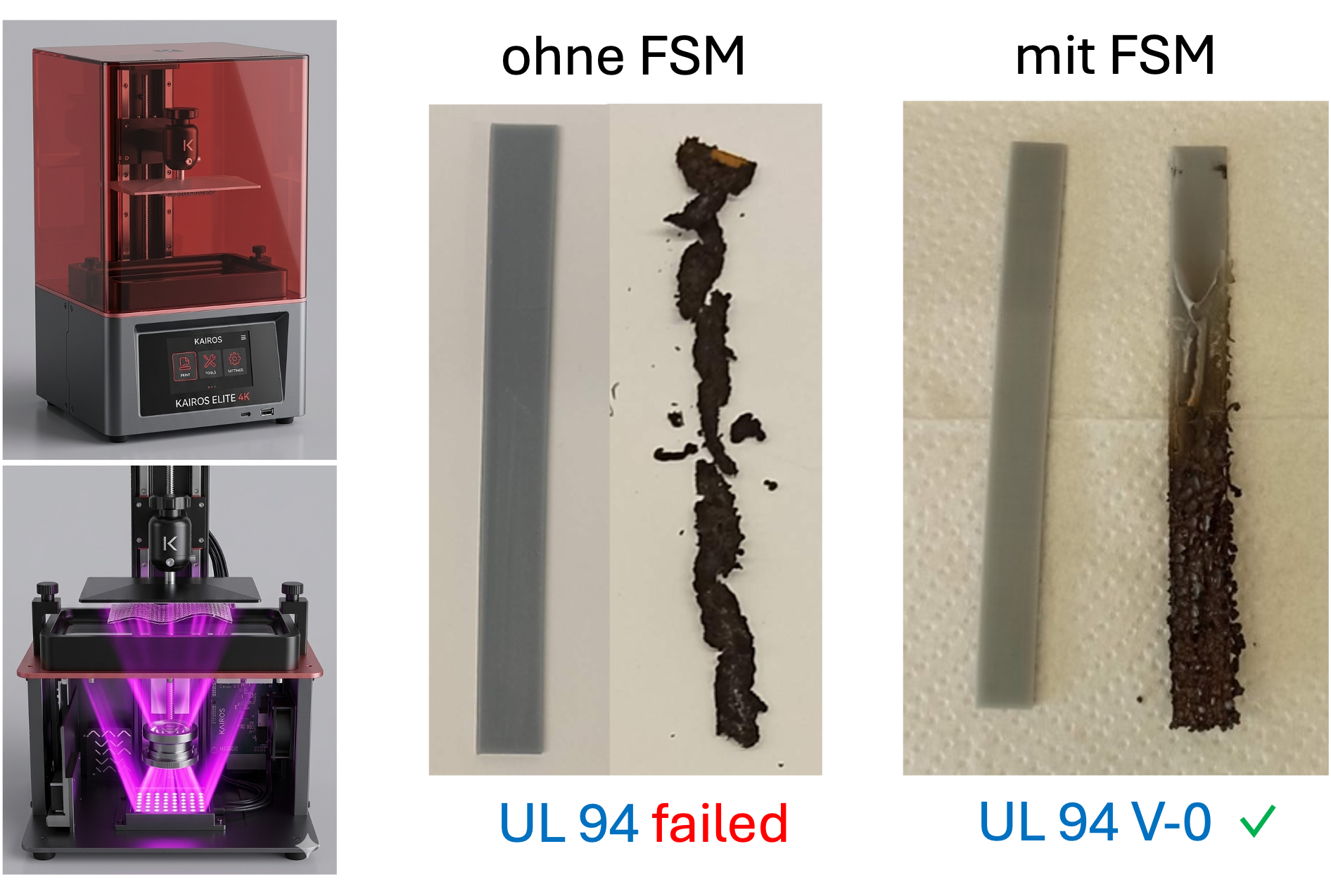
Figure 1: Comparison of the fire behavior of SLA/DLP printed samples without and with flame retardant (FR). While the sample without flame retardant fails the UL 94 test, the flame-retarded sample achieves a V-0 rating, demonstrating significantly improved fire performance.
Project Information:
Title: Acrylate-Based Flame Retardants for SLA & DLP 3D Printing
Acronym: FSM–Resine
Grant: 01IF24014N
Runtime: 01.07.2025 – 31.12.2027
Project partners: The German Textile Research Center North-West gGmbH, Krefeld
SKZ KFE gGmbH – Das Kunststoffzentrum, Additive Fertigung, Würzburg
Contact DTNW: Dr. Thomas Mayer-Gall, Tel.: +49-2151-843-2015, e-Mail: mayer-gall@dtnw.de
Dr. Wael Ali, Tel.: +49-2151-843-2029, e-Mail: ali@dtnw.de
Contact SKZ: Benjamin Escudero, Tel.: +49 931 4104-4126, e-Mail: b.escudero@skz.de
Adrian Beetz, Tel.: +49 931 4104-642, e-Mail: a.beetz@skz.de
Download: