Biobased Finishing
Hydrophobic finishing made from multifunctional acrylic monomers derived from used cooking oil
The textile industry is increasingly focusing on sustainable production. Hydrophobic polymers based on plant oils represent a promising environmentally friendly alternative to conventional hydrophobizing agents based on fossil raw materials or fluorine chemistry.
The project developed a bio-based water repellent in which hydrophobic acrylic monomers derived from vegetable oil were used as multifunctional building blocks in copolymers. Their double bonds in the fatty acid chains enable cross-linking of the coating on the textile. This additional cross-linking option was seen as a functional added value of vegetable oil-based monomers.
At the same time, the potential of used cooking oil as an alternative raw material for direct chemical synthesis was investigated. For this purpose, samples were collected from different companies and analyzed physically and chemically. Although used cooking oils are suitable for the synthesis of hydrophobic acrylic monomers, the thermal stress during use reduces the oxidation delay.
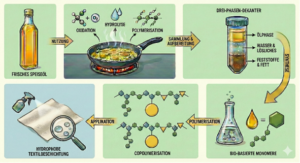
Based on these results, the polymer design in the project was geared towards sustainability aspects. Both saturated and unsaturated monomers were investigated. These were converted into copolymers with aliphatic side chains in order to evaluate the polymerization, latex stability, and hydrophobic effect of the coatings.
Polymerization was carried out in aqueous dispersion to make the finishing systems even more sustainable. Due to the highly hydrophobic and only slightly water-soluble monomers, the mini-emulsion polymerization process was required for this. The optimization of this process by varying the monomer composition and the mini-emulsion formulation was a central and complex part of the project.
The best results in terms of synthesis stability and hydrophobic effect were achieved with a combination of 40% Terra and 50% IBOMA, 10% compatibilizer monomer. With an application quantity of 1–2%, the individual fibers could be coated without changing the mechanical or haptic properties of the textiles. The hydrophobic effect achieved on PET and cotton fabrics was comparable to commercial wax and silicone-based finishing systems. At the same time, a bio-based carbon content of over 70% was achieved in the coating. The use of commercially available monomers and aqueous polymerization processes creates favorable conditions for industrial transfer. The project goals were thus successfully achieved and concrete recommendations for the sustainable development of bio-based textile finishes were derived.
Project Information:
Title: Hydrophobic finishing made from multifunctional acrylic monomers derived from used cooking oil
Acronym: Biobased Finishing
Project number: 22921 N
Project duration: 01.06.2023 – 30.11.2025
Contact DTNW: Dr. Habil. Larisa Tsarkova,
Tel.: +49-2151-843-2016
e-mail: tsarkova@dtnw.de
Keywords: Superhydrophobic finishing, water-repellent coating, vegetable oils, used cooking oil, emulsion polymerization
Weitere Informationen zum Download: